
KEY TAKEAWAYS
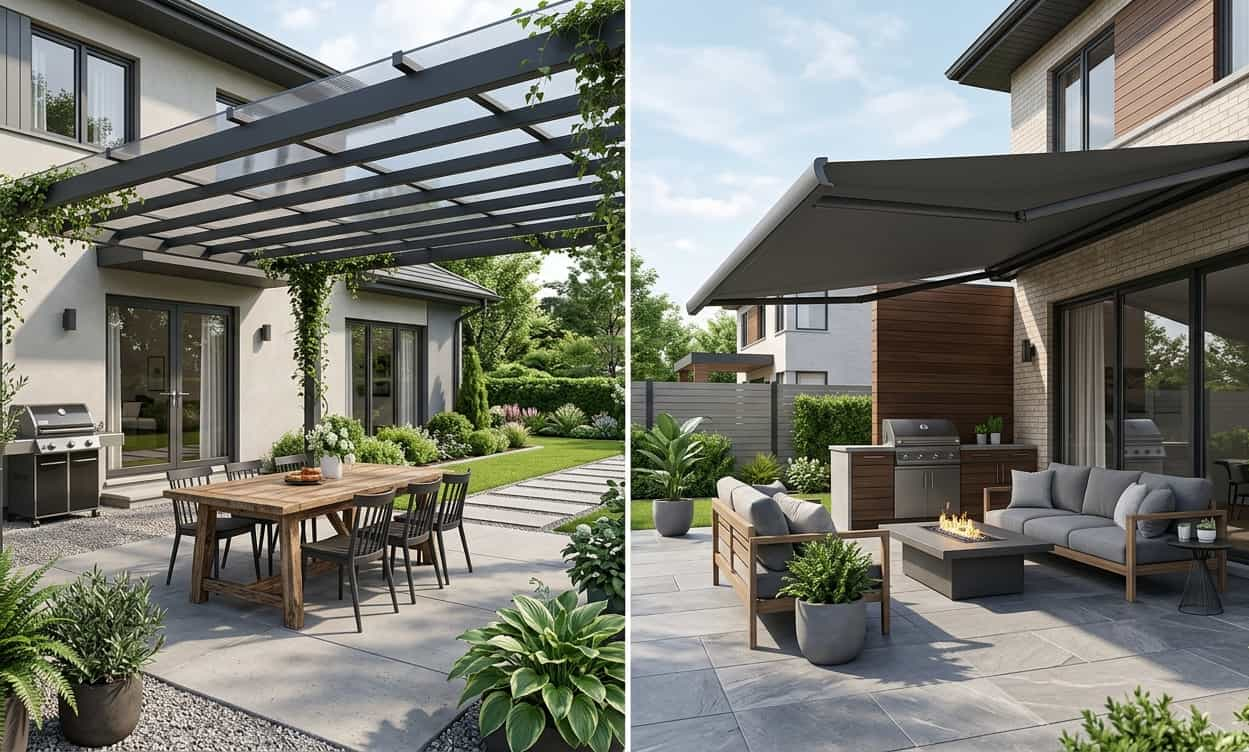
- Pergolas create defined outdoor living spaces, while awnings provide flexible shade coverage
- Awnings are more affordable upfront and easier to install
- Louvered pergolas offer all-weather protection and year-round usability
- Climate and intended use should guide your decision
- Pergolas typically deliver stronger long-term value and property impact
TABLE OF CONTENTS
You’ve spent good money on your outdoor space. The deck is solid, the patio looks great, and the furniture is exactly right. But every time summer rolls around, the sun wins. You end up inside sooner than expected, furniture fades faster than it should, and the space you invested in goes underused.
Both pergolas and awnings fix that problem. They block the sun, extend your time outdoors, and improve the livability of your backyard in a real, tangible way. The difference is in what they offer beyond shade, and that’s where most homeowners get stuck comparing the two.
The right call depends on your space, your climate, how you use your backyard, and how much permanence you actually want. Understanding each structure clearly is the fastest way to stop guessing and start deciding.
What Is an Awning?
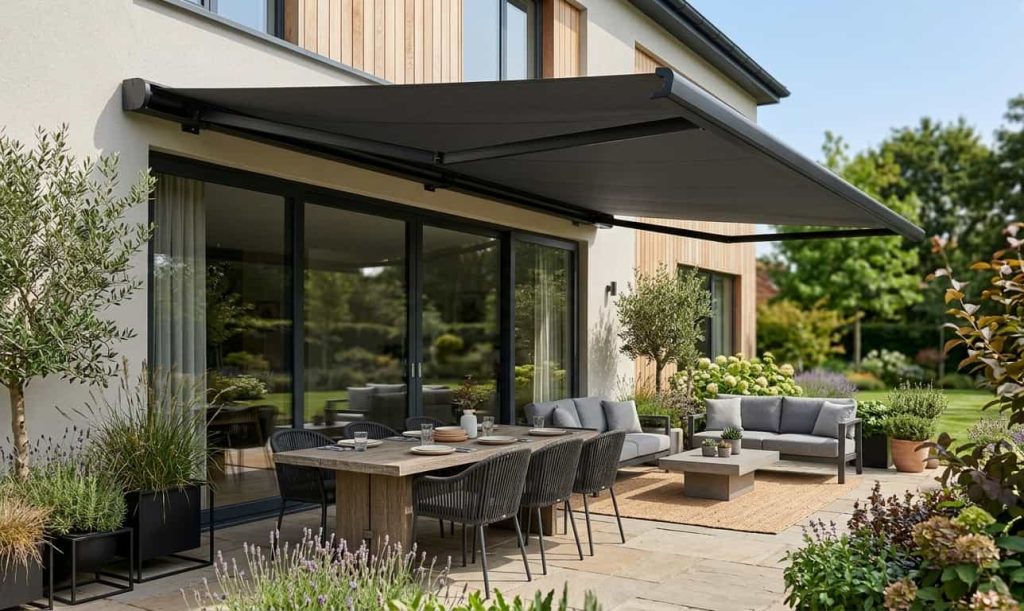
An awning is a roof-like covering, typically made of fabric or metal, that extends outward from the wall of a building. It mounts directly to the exterior, which is usually a fascia board, wall, or soffit, and projects over a deck, patio, window, or entryway to provide shade and a layer of weather protection.
Because awnings attach to an existing structure, they’re a practical fit for homeowners who want added coverage without altering their outdoor footprint. Modern awning fabrics, like solution-dyed acrylic, are built to resist UV degradation and water penetration. According to the U.S. Department of Energy, awnings on south-facing windows can reduce solar heat gain by up to 65%, which adds meaningful energy efficiency to their list of benefits.
Types of Awnings
Retractable Awnings
Retractable awnings extend and retract on demand. Most modern installations are motorized, making operation as simple as pressing a button. Wind sensors can be added to trigger automatic retraction when gusts exceed a safe threshold. They’re an excellent option for homeowners who want shade on their terms without committing to a permanent structure overhead.
Fixed (Stationary) Awnings
Fixed awnings stay in position permanently. They’re typically used over patios, poolside areas, or entryways where consistent shade is needed regardless of conditions. Optional drop screens can be added to block low-angle sun and extend the usability of the covered area into the evening hours.
Commercial Awnings
Designed for businesses, commercial awnings serve a dual purpose: shade and brand visibility. Custom graphics, logos, and signage can be applied directly to the fabric, turning a functional shade structure into a marketing asset.
What Is a Pergola?
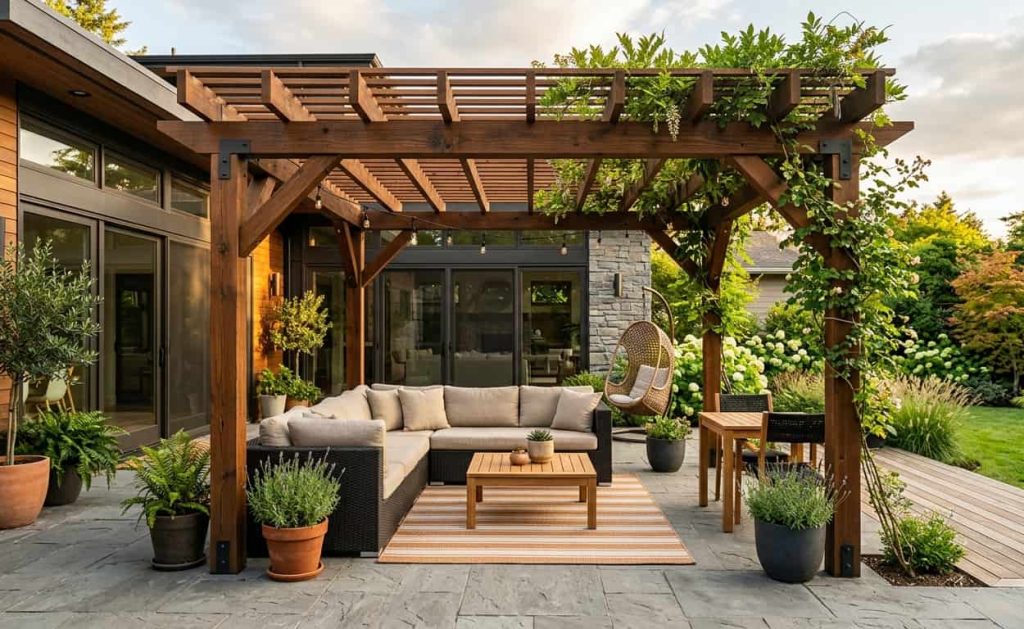
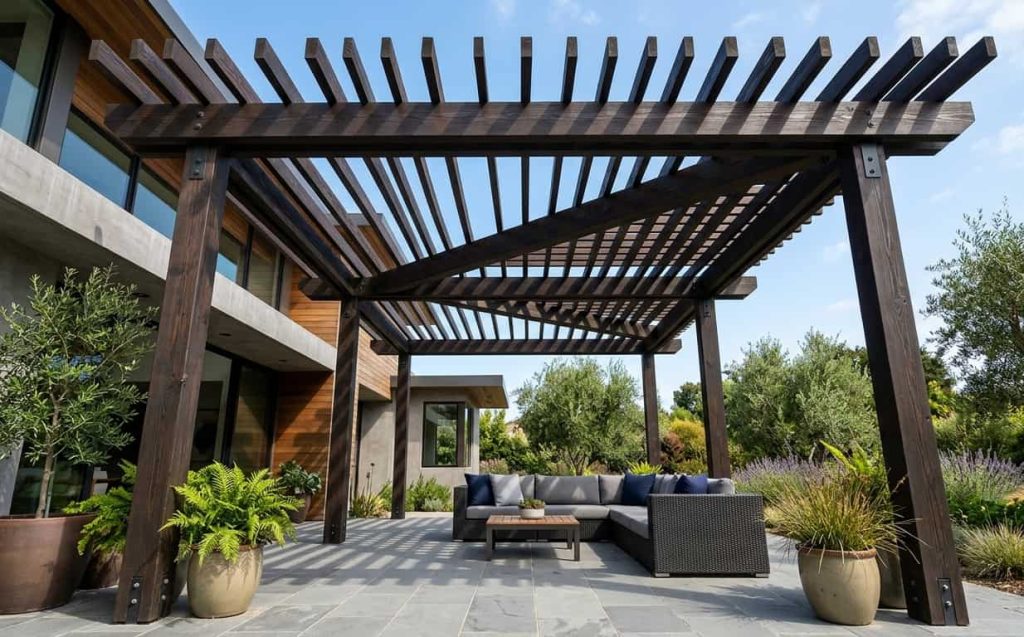
A pergola is a freestanding or attached outdoor structure made of vertical posts and horizontal crossbeams. Its traditional design features an open roof that creates partial shade through the spacing of the beams. More importantly, a pergola helps define a space. It transforms an open deck or patio into a purposeful outdoor room that feels like an intentional extension of your home’s design.
Traditional pergolas are typically constructed from wood or vinyl. They add visual character, but their open-beam design offers limited protection from rain or intense midday sun, and wood models require regular maintenance to stay in shape.
Traditional vs. Louvered Pergolas
The more significant distinction for today’s homeowners is between traditional pergolas and modern louvered systems.
Traditional Pergolas use fixed, open beams that allow light and air to pass through. They’re aesthetically appealing and work well in mild climates, but they’re not designed for reliable weather protection.
Louvered Pergolas represent a meaningful upgrade. Built from powder-coated aluminum, these systems feature adjustable roof louvers that open to let in sunlight and close to block rain entirely. Smart-home integration, built-in lighting, heating elements, and motorized screens can all be added. The result is an outdoor room that functions year-round, not just on perfect-weather days.
Pergola vs. Awning: Head-to-Head Comparison
Both structures solve the same core problem. Where they differ is in the scope of what they deliver.
Installation and Space Requirements
Awnings mount to an existing wall or fascia, making installation relatively straightforward and space-neutral. They don’t require post footings or significant structural groundwork.
Pergolas, whether attached or freestanding, require more planning. Post placement, footing depth, and structural anchoring all factor into the install. Depending on your municipality, a permit may be required. Always verify with your local building department before starting any pergola project, as requirements vary by location.
Weather Protection
Retractable awnings perform well for sun coverage and light rain, but they’re not engineered for high winds when fully extended. Fixed awnings offer more durability in wind but remain fabric-based, which limits heavy-weather performance.
Louvered pergolas operate differently. When the louvers close, the structure provides full overhead protection from rain. This makes them a viable year-round solution in climates that see real seasonal variation, like the Northeast.
Customization and Aesthetics
Awnings offer a wide range of fabric colors, patterns, and sizes. They’re highly customizable in terms of coverage dimensions and appearance, but they read as a shade solution, not an architectural feature.
A pergola creates a different kind of statement. It is a permanent, structural addition to your outdoor space that can incorporate lighting, screens, heaters, ceiling fans, and more. The aesthetic impact is significant.
Cost Considerations
Awnings represent the lower upfront investment. Retractable fabric awnings are available across a range of budgets, and even premium motorized models typically cost less than a full pergola installation.
Louvered aluminum pergolas sit at a higher price point, but they add measurable value as a permanent outdoor living structure. A National Association of Realtors report on outdoor living features found that outdoor improvements consistently deliver strong value appeal to buyers. Specific returns vary by market, but the long-term utility of a year-round structure tends to outperform a seasonal shade product over time.
Maintenance
Quality retractable awnings are low-maintenance. Retracting them during storms and at the end of the season significantly extends fabric life. Fixed awnings require periodic cleaning but otherwise need minimal attention.
Powder-coated aluminum pergolas are even simpler. There’s no seasonal stowing, no refinishing, and no rust concern. The material is built to last outdoors without intervention.
How to Choose Between a Pergola and an Awning: A Step-by-Step Guide
Working through these five considerations in order will give you a clear direction before you ever call a contractor.
Step 1: Define Your Primary Goal
If the objective is straightforward sun coverage over a specific zone, an awning is likely sufficient. If the goal is to create a defined outdoor living space you can use for dining, entertaining, or relaxing across multiple seasons, a pergola is the stronger fit.
Step 2: Assess Your Available Space
Awnings work well for narrower footprints or wall-adjacent areas where post installation isn’t practical. Pergolas need adequate space for posts, clearance, and structural footings. Measure your deck or patio realistically before narrowing down options.
Step 3: Factor In Your Local Climate
In regions with heavy seasonal rain, high humidity, or northeast-style winters, a louvered pergola’s ability to seal out weather is a significant advantage. In milder climates with limited rainfall, a retractable awning may offer all the coverage you actually need.
Step 4: Set A Realistic Budget
Think beyond the installation cost. Factor in long-term value, maintenance requirements, and how the investment affects your property. A louvered pergola typically costs more upfront but delivers more usable hours per year and a higher ceiling for resale value.
Step 5: Check Local Permitting Requirements
Awnings generally don’t require permits, but rules vary by town and county. Pergolas more commonly trigger permit requirements due to their footings and permanent structure. Confirm the rules with your local building department, or work with a licensed local installer who knows the regulations in your area.
- If budget is the primary constraint and the need is simple seasonal shade, an awning is a practical and effective starting point.
- If the goal is a permanent outdoor room that holds up in any season, a pergola is the better long-term investment.
What Is a Pergola Awning and Do You Need One?
The term “pergola awning” appears frequently in searches and comes up in two distinct ways. In some cases, it refers to an awning that’s been integrated with or attached to a pergola structure as an add-on shade component. In others, it’s simply how people describe a structure that combines architectural form with functional shade coverage.
Some traditional pergola setups incorporate retractable fabric canopies over the open-beam roof, effectively adding an awning layer to the structure. This was once a popular way to get more weather protection from a classic pergola design.
Today, fully louvered pergolas have largely replaced that hybrid approach. Adjustable aluminum louvers deliver the same on-demand shade and rain protection as a retractable canopy, but in a cleaner, more durable, and more integrated form. There’s no fabric to replace, no separate retraction system to manage, and no visual inconsistency between two layered products.
If you’re drawn to the idea of a pergola awning because you want both a defined outdoor structure and reliable weather control, a louvered pergola delivers exactly that in a single, unified system.
Frequently Asked Questions
What is the difference between a pergola and an awning?
A pergola is a freestanding or attached outdoor structure that creates a defined room-like space using vertical posts and crossbeams. An awning is a fabric or metal covering that mounts to a building wall and extends outward to provide shade. Pergolas offer more structural presence and design flexibility; awnings offer simpler, lower-footprint coverage.
Is an awning cheaper than a pergola?
Generally, yes. Retractable and fixed awnings typically require a lower upfront investment than a full pergola installation, particularly when comparing against premium louvered aluminum systems. That said, pergolas tend to offer greater long-term property value and year-round functionality, which changes the cost-benefit calculation for many homeowners.
Can a pergola protect from rain?
Traditional open-beam pergolas offer very limited rain protection. Louvered pergolas are a different story. When the adjustable roof slats are fully closed, they provide complete overhead coverage from rain, making them a practical all-weather structure in variable climates.
Do awnings add value to a home?
Awnings contribute to energy efficiency, curb appeal, and outdoor usability, all of which can positively influence a home’s perceived value. A well-designed pergola, particularly a permanent louvered system, generally commands a more substantial value impact as a structural outdoor living addition.
How long do retractable awnings last?
Quality retractable awnings with durable solution-dyed acrylic fabrics and powder-coated aluminum frames typically last 10 to 15 years or more with proper care. Retracting the awning during storms and storing it correctly during the off-season are the two factors that have the greatest impact on lifespan.
Ready to Upgrade Your Outdoor Space? Here's Your Next Step
Both awnings and pergolas are proven solutions for making your backyard more livable, more comfortable, and more valuable. The right choice comes down to how you use your space, what your climate demands, and how much you want from your investment.
For a simple seasonal shade solution, a quality retractable awning gets the job done. For a true outdoor room built to perform in any weather, a louvered pergola is in a different category entirely. Many homeowners in the Northeast find that once they experience year-round usability from a louvered system, there’s no going back.
Durkin’s has been designing and installing custom awnings and pergola systems across Connecticut and New York since 1904. Their team will assess your space, walk you through the options, and provide design renderings before any commitment is made, so you can see exactly what you’re getting.
Contact Durkin’s today to schedule your no-obligation consultation.


